
IMUGA portal help
Maldives Green Tax and Airport Fees
A practical breakdown of the charges on a Maldives holiday: green tax per night, TGST on tourism services, airport fees inside your ticket and resort service charge.
Almost every traveller arriving in the Maldives meets the same three acronyms on a bill: green tax, TGST and service charge, plus a set of airport fees that were quietly bundled into the air ticket months earlier. None of them is collected by the IMUGA portal, and none of them has anything to do with the Traveller Declaration. This guide explains who charges what, at which moment, and how to read a resort invoice line by line so the final folio never surprises you.
Short answer: Green tax is a per-person, per-night environmental charge collected by your accommodation. TGST is a goods and services tax on tourism services that is already built into resort and guesthouse pricing. Airport and departure charges are normally included in the price of your air ticket. The Maldives Immigration Traveller Declaration submitted on IMUGA has no cost and is completely separate from all of them.
Why Maldives bills look more complicated than they are
The Maldives runs a tourism economy on a scatter of small islands, and the tax system reflects that. Instead of one flat charge, the country layers a few specific ones: an environmental levy tied to nights slept, a consumption tax tied to tourism services, aviation charges tied to using the airport, and a private service charge that hotels add on top. Each has a different legal basis and a different collector.
That layering is why two quotes for "the same" week can differ by a noticeable margin. One agency quotes a rate that already folds in taxes and service charge; another quotes the bare room rate and adds everything at check-out. Neither is wrong. They are simply presenting the same total in different ways.
For planning purposes, the useful mental model is this: you pay the government indirectly, through businesses. You will rarely hand money to a public counter in the Maldives. The resort, the guesthouse, the liveaboard operator and the airline collect on the state's behalf and remit it later.
In short: the complexity is presentational, not procedural — several collectors, one traveller, one final total.
Green tax: the environmental levy per person, per night
Green tax is an environmental charge applied to tourists staying overnight in the Maldives. The unit of account is simple: one person, one night. Ten nights for two adults means twenty chargeable person-nights, subject to whatever exemptions apply to young children at the time of travel.
The rate is not uniform across the whole country. Maldivian policy has historically distinguished between tourist resorts, hotels and liveaboard vessels on one side, and guesthouses on inhabited local islands on the other, with the second category paying a lower per-night amount. There have also been exemptions for children below a certain age. Both the amounts and the age thresholds have been revised over the years.
That is exactly why this article does not quote figures. A number that was accurate two seasons ago may be wrong today, and an outdated number in a budget is worse than no number at all.
- Ask your accommodation directly. A one-line email to the reservations desk — "what is the current green tax per person per night for my room category, and is it already included in my quoted rate?" — settles it.
- Check the confirmation voucher. Many properties itemise green tax as a separate line even when it is prepaid.
- Confirm the child policy. If you travel with young children, ask whether they are exempt and up to what age.
- Remember liveaboards count. Nights spent aboard a safari boat are chargeable nights, not travel days.
Worth knowing: green tax follows nights, not days. A late-night arrival that puts you in a room after 23:00 still creates a chargeable night. Conversely, a long day-use room with no overnight stay usually does not.
In short: green tax is per person, per night, collected by your accommodation, and the rate depends on the property type — confirm the current amount with the property itself.
TGST: the tax on tourism goods and services
TGST is the tourism-sector branch of the Maldivian goods and services tax. It applies to what tourism businesses sell: accommodation, food and beverage in tourist establishments, excursions, spa treatments, dive packages, seaplane and speedboat transfers sold by tourism operators, and similar services.
Unlike green tax, TGST is a percentage of the amount spent, not a fixed sum per night. So it scales with your consumption. A quiet week of half board produces a modest TGST line; a week of à la carte dining, wine and daily diving produces a larger one.
You almost never have to calculate it. Tourism businesses in the Maldives are required to show it, and it appears on the folio automatically. What matters for budgeting is knowing whether your quoted rate is inclusive or exclusive. The phrases to look for on a booking confirmation:
- "Rates are inclusive of all applicable taxes and service charge" — the number you see is close to the number you will pay.
- "Rates are subject to applicable taxes and service charge" — expect a meaningful uplift at check-out.
- "Plus plus" or "++" after a price — an old hospitality shorthand meaning tax and service charge are still to be added.
- "Nett" or "net rates" — usually means nothing further will be added, but confirm it in writing.
In short: TGST is a percentage tax on tourism spending that appears automatically on your bill; the only thing to verify is whether your rate was quoted inclusive or exclusive.
Airport and departure charges: already inside your ticket
Travellers often ask where to pay the Maldivian departure charge at Velana International Airport (MLE). In normal circumstances, the answer is: you already did, when you bought the flight.
Airport service charges and departure-related fees for international passengers are typically collected by airlines at the point of ticket sale and passed on to the airport operator. On an e-ticket receipt they hide inside the tax breakdown — that block of three-letter codes under the base fare that most people never expand. There is no cash desk to visit before immigration.
A few consequences worth internalising:
- You do not need local currency for departure. Budgeting cash "for the airport tax" is unnecessary for a standard scheduled flight.
- Different traveller categories may be treated differently. Charges for residents, transit passengers and different cabin classes are not always identical.
- Domestic legs are their own thing. A domestic hop from Malé to Gan (GAN), Maafaru (NMF) or Hanimaadhoo (HAQ) carries its own fare structure.
- Private and charter aviation is separate. Private jet handling is billed through the handling agent, not through a passenger counter.
If you arrive by sea rather than by air, the aviation charges obviously do not apply, but port and agency costs may. That scenario is covered in our guide on arriving in the Maldives by cruise or yacht.
In short: for scheduled flights, airport and departure charges are embedded in the ticket price — there is nothing to pay at the terminal.
Service charge: private, not a tax
The service charge is the line travellers most often mistake for a tax. It is not one. It is a percentage the property adds to the bill and distributes to staff, following a long-standing hospitality convention that the Maldives applies widely.
Three practical points:
- It is calculated on the value of services, so it grows with what you consume.
- It is normally applied before the consumption tax, meaning the tax base includes the service charge. That is why "10% plus 16%" is not the same as "26%".
- It is distributed to staff, which is precisely why additional tipping is optional rather than expected.
Because the service charge is a private commercial arrangement rather than a government levy, its treatment can vary between a five-star resort, a small guesthouse and a liveaboard. Guesthouses on local islands sometimes do not apply one at all.
Worth knowing: the compounding order matters. When you model a budget, apply service charge to the net amount first, then apply the consumption tax to that subtotal, then add green tax as a flat per-night figure on top. Green tax does not scale with your restaurant bill.
In short: service charge is a private staff distribution, not a tax, and it forms part of the base on which consumption tax is calculated.
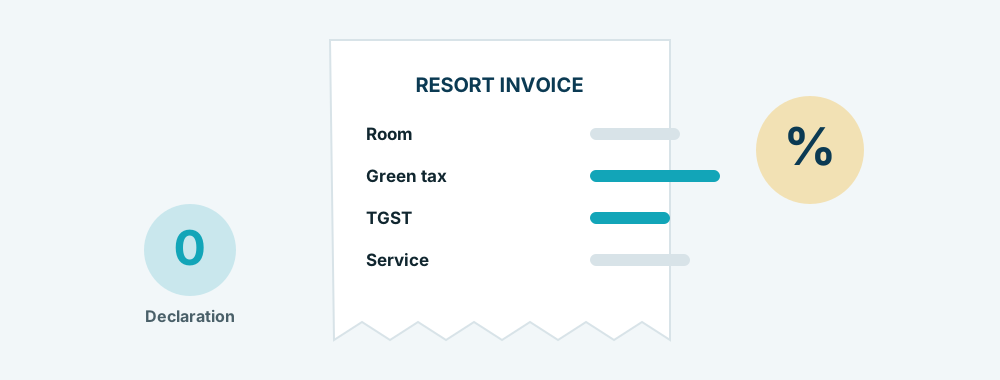
How to read a resort invoice, line by line
A typical Maldives folio at check-out has a predictable shape. Reading it in the right order takes thirty seconds and prevents almost every dispute.
| Line on the folio | What it represents | Where to check it |
|---|---|---|
| Room / package charge | The negotiated nightly rate for your category | Against your booking voucher |
| Meal plan supplement | Upgrade from the plan included in the rate | Against what you actually agreed at check-in |
| Food and beverage extras | Anything signed for outside the plan | Against your signed chits |
| Excursions, spa, diving | Activities booked on the island | Against your activity confirmations |
| Transfers | Seaplane or speedboat, if not prepaid | Against your transfer confirmation |
| Service charge | Percentage on services, distributed to staff | Confirm the stated percentage |
| Consumption tax (TGST) | Percentage on the taxable subtotal | Confirm it applies once, not twice |
| Green tax | Person-nights multiplied by the current rate | Recount your person-nights |
| Prepayments / deposits | What you already paid the agency or property | Against your payment receipts |
The two most common genuine errors are a miscounted person-night — usually a child included when they should be exempt, or an extra night from an early arrival — and a duplicated extra already covered by your package. Both are easy to raise politely at the desk with the voucher in hand.
Ask for the itemised folio the evening before departure rather than in the queue on your last morning. Check-out mornings in the Maldives are compressed by transfer windows, and nobody wants to argue about a spa charge with a seaplane waiting.
In short: read the folio bottom-up from the totals to the person-night count, and request it the night before you leave.
Who collects what, and when

| Concept | Who charges it | When you pay it |
|---|---|---|
| Green tax | Your accommodation (resort, hotel, guesthouse or liveaboard) | At check-out, or prepaid inside a package |
| TGST on tourism services | Every tourism business you buy from | Continuously, embedded in each bill |
| Airport and departure charges | The airline, on behalf of the airport | When you buy the air ticket |
| Resort service charge | The property itself, for its staff | At check-out, on the folio |
| Seaplane / speedboat transfer | Resort or transfer operator | Prepaid with the booking, or on the folio |
| Domestic flight | The domestic carrier | When you buy the domestic ticket |
| Optional tips | Nobody — entirely voluntary | Whenever you choose |
| Traveller Declaration (IMUGA) | Nobody — it has no cost | Never |
That last row is the important one. The Maldives Immigration Traveller Declaration is submitted at no cost on the official IMUGA portal, within the 96 hours before each flight, and it generates a QR code by email. It is a border formality, not a fiscal one. If anything asks you to "pay the green tax" as part of a declaration form, you are not on the official portal.
In short: taxes are collected by businesses at defined moments; the declaration itself never carries a government fee.
Budgeting a Maldives trip without nasty surprises
A realistic budget for the Maldives is built in layers, in this order:
- International flights, taxes and airport charges already included.
- Accommodation, checking carefully whether the rate is quoted inclusive or exclusive.
- Transfers, which in the Maldives are a major cost line rather than a footnote — seaplanes in particular, and they only operate in daylight.
- Green tax, calculated as travellers multiplied by nights multiplied by the current per-night rate for your property type.
- Food and drink outside the meal plan, remembering that service charge and tax will be applied on top.
- Activities: diving packages, excursions, spa, all taxable.
- A contingency margin for the extras that always appear.
Two structural realities to build in. First, transfers can rival the room in cost, so a cheaper island that is far from Malé is not automatically cheaper overall. Second, alcohol is only served under licence in resorts and cannot be imported — the rules are set out in our guide to entry rules and customs restrictions — so a drinks budget belongs in the plan if you intend to drink.
If you are staying on a liveaboard or splitting the trip between a resort and a local island, the accommodation section of your declaration needs care; see accommodation, resorts and liveaboards on IMUGA.
In short: budget in layers, treat transfers as a headline cost, and compute green tax as a simple person-night multiplication.
Tipping on top of the service charge
Because the service charge already goes to staff, tipping in the Maldives is genuinely optional. That said, it is common and appreciated, particularly for people whose work is very individual.
- Your butler or villa host, if the resort operates that model and the service was personal.
- Dive guides and instructors, especially after a multi-day package with the same team.
- The boat crew on a liveaboard, often through a shared box divided among everyone aboard.
- Housekeeping, left in the villa rather than handed over.
Practical notes: US dollars are widely accepted in resorts and are the easiest currency for tipping; small denominations are far more useful than large ones; and cards are not helpful here, so bring some cash if you intend to tip. On local islands, the culture is more modest and smaller amounts are entirely normal.
In short: tipping is voluntary because the service charge already distributes to staff — bring small notes if you want the option.
Common misunderstandings worth clearing up
- "I have to pay green tax at the airport." No. Your accommodation collects it.
- "The Traveller Declaration has a fee." No. It has no cost on the official IMUGA portal. Only optional assistance services charge anything, and they are private companies, not the government.
- "The tourist visa costs money." Most nationalities receive a no-cost 30-day visa on arrival with a valid passport, a confirmed booking, an onward ticket and sufficient funds.
- "Green tax scales with the room price." It does not. It is a flat per-person, per-night amount that depends on property type, not on how luxurious the villa is.
- "Service charge is a government tax." It is not; it is a private distribution to staff.
- "Children pay the same as adults." Often not — exemptions have historically existed for young children. Confirm the current threshold.
If you are connecting through Malé to another destination and never clearing immigration, your tax exposure is different again; see transit and connecting flights in the Maldives.
Worth knowing: the cleanest way to avoid every one of these misunderstandings is to ask one written question before you travel — "is my quoted rate inclusive of green tax, TGST and service charge?" — and keep the reply.
In short: most confusion comes from mixing up who collects what; the declaration has no cost, and green tax never touches the airport.
Key points
- Green tax is charged per person, per night, by your accommodation, with different rates for resorts and guesthouses.
- TGST is a percentage tax on tourism services and is already reflected in the bills you receive.
- Airport and departure charges for scheduled flights are collected inside the air ticket, not at the terminal.
- The resort service charge is a private distribution to staff, not a government tax, and it forms part of the tax base.
- The Maldives Immigration Traveller Declaration has no cost on the official IMUGA portal and unrelated to any of these charges.
- Rates and exemptions change; confirm the current figures with your accommodation or the official portal rather than trusting an old blog post.
FAQ about Maldives taxes and fees
Do I pay green tax at the airport when I leave?
No. Green tax is collected by your accommodation, either at check-out or prepaid inside a package. There is no green tax counter at Velana International Airport, and you do not need to reserve cash for it.
Is green tax the same at a resort and at a guesthouse?
Historically no. Maldivian policy has distinguished between tourist resorts, hotels and vessels on one side and guesthouses on inhabited islands on the other, with a lower per-night amount for guesthouses. Confirm the current rate for your specific property type.
Do children pay green tax?
Exemptions for young children have existed, with an age threshold that has been revised over time. Ask your accommodation to confirm both the current threshold and whether your children fall under it before you build your budget.
What exactly does TGST cover?
It applies to goods and services sold by tourism establishments: rooms, food and beverage, excursions, spa, diving and tourism transfers. It is a percentage of what you spend, so it grows with your consumption rather than with the number of nights.
Is the airport departure charge included in my ticket?
For scheduled international flights, yes, in normal circumstances. Airlines collect airport-related charges at the point of sale and pass them on. They appear inside the tax block of your e-ticket receipt rather than as a separate payment at the terminal.
Does the Traveller Declaration cost anything?
No. Submitting the Maldives Immigration Traveller Declaration on the official IMUGA portal has no cost. Any charge you see is either an optional private assistance service or a site that is not the official portal. We are an independent paid assistance agency, never the government.
Why is my final bill higher than the rate I booked?
Almost always because the quoted rate was exclusive. Look for "++", "plus taxes" or "subject to applicable taxes and service charge" on the confirmation. Add service charge first, then the consumption tax on that subtotal, then green tax per person-night.
Is the service charge obligatory?
It is a standard commercial practice applied by most resorts and stated in their terms, so in practice you should budget for it. It is not a government tax, and it is distributed to staff rather than remitted to the state.
Do I still need to tip after paying service charge?
Not obligatorily. The service charge already goes to staff. Many travellers still tip dive guides, butlers and boat crew for personal service. Small-denomination US dollar notes are the most practical option.
Do liveaboards pay green tax too?
Yes. Nights spent aboard a safari boat count as chargeable nights and the operator collects the applicable amount, just as a resort would. Check whether your dive package quote already includes it.
Last updated: July 2026. Immigration rules change; always confirm current requirements on the official Maldives Immigration portal before travelling.