
IMUGA portal help
Maldives Transit and Connecting Flights
How transit, same-day connections, domestic hops and seaplane transfers affect your IMUGA Traveller Declaration, with a table for every connection type.
Almost nobody flies to the Maldives non-stop. Itineraries stack up through Doha, Dubai or Istanbul, land at Velana International (MLE) and then continue by seaplane or domestic flight. That layering is exactly where the Traveller Declaration gets confusing: which leg do you declare, and does a connection count as entering the country?
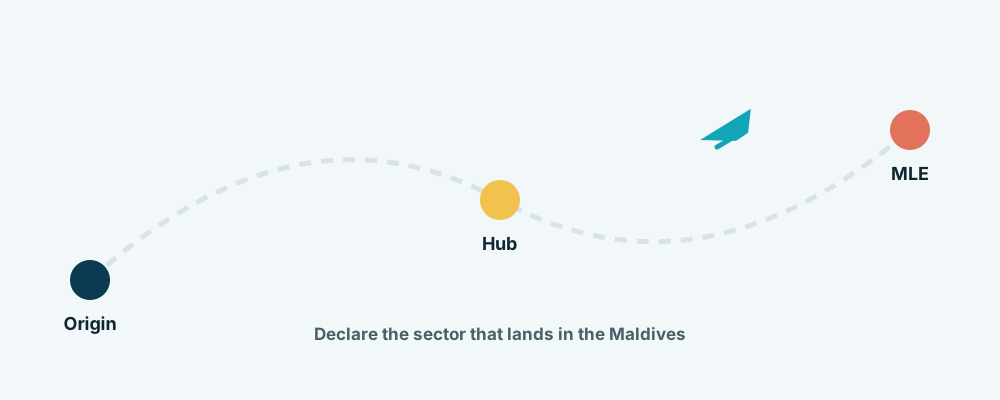
Short answer: you declare the flight that brings you into the Maldives, not the intermediate stop abroad. If you clear immigration at Velana - which almost every leisure traveller does, even to reach a resort - you need an arrival declaration through the IMUGA portal. Pure airside transit without crossing the border is the rare exception.
We are an independent paid assistance service, not Maldives Immigration. Use the official IMUGA portal for the submission itself; this page is about deciding what to put on it.
Transit without crossing immigration, and actually entering
The distinction that governs everything else is whether you cross the border.
Airside transit means you stay in the international zone. You arrive on one international flight, remain in the terminal, and leave on another international flight without your passport being stamped into the country. Your checked bags travel through to the final destination. You never legally enter the Maldives.
Entry means you pass the immigration desk, collect your bags at Velana, and step into the arrivals hall. That is where the no-cost 30-day visa on arrival is granted to most nationalities, and it is where your QR code gets scanned.
Here is the part travellers underestimate: almost every trip to a Maldivian resort is an entry, not a transit. A seaplane to a private island departs from a separate terminal on the landside of the airport. A domestic flight to Gan or Maafaru is a domestic flight, taken after entry formalities. Even a resort you reach twenty minutes after landing involves crossing immigration.
- Airside transit: rare, usually only on itineraries that route through MLE to another country.
- Entry then seaplane: standard for resort guests, requires a declaration.
- Entry then domestic flight: standard for the southern atolls, requires a declaration.
- Entry then speedboat: standard for Malé-area resorts, requires a declaration.
In short: if your passport gets stamped, you have entered, and you declare.
Same-day connections at Velana (MLE)
The typical resort arrival looks like this: a long-haul flight lands mid-morning, you clear immigration, a resort representative meets you in the hall, and you are on a seaplane by early afternoon.
For the declaration, that whole sequence is one arrival. You submit a single arrival declaration covering the international flight into MLE. The seaplane or domestic hop that follows is internal movement inside the Maldives and does not generate its own declaration or its own QR code.
What you do need to get right on the form is the accommodation. Whether you sleep on a private island, in a Malé hotel or on a liveaboard, that is the address immigration expects. See our note on accommodation, resorts and liveaboards if your stay is split across several properties.
Worth knowing: the QR code from your arrival declaration is checked at the airline counter before you leave home and again at the immigration desk in Malé. Nobody scans it for the seaplane. Resort transfer staff care about your booking, not your declaration.
In short: one international arrival equals one declaration, regardless of how many internal legs follow.
Connecting to a domestic flight or a seaplane
The onward leg does not change your declaration, but it does change your day, and it is worth planning around.
Seaplanes operate only in daylight. They do not fly at night, and the last departures cluster in the late afternoon. If your international flight lands after that cut-off, you are not reaching the resort by air that day - you will either overnight near the airport or take a speedboat, depending on distance and sea conditions. Resorts know this and will usually tell you at booking, but it catches people who change flights later.
Domestic flights to airports such as Gan (GAN), Maafaru (NMF) and Hanimaadhoo (HAQ) run on published schedules and do fly after dark, so they are less weather- and daylight-dependent than seaplanes. They connect to speedboat transfers at the other end.
Speedboats are the most flexible option and the one that rescues late arrivals, though longer crossings at night are avoided by some operators.
Planning points:
- Check the last seaplane departure of the day against your scheduled landing time.
- Add margin for immigration queues, which peak when several wide-bodies land together.
- Confirm the transfer with the resort in writing, including what happens if you arrive late.
- If the transfer slips to the next morning, budget for a night near the airport.
In short: the onward leg does not need declaring, but daylight rules can reshape your arrival day.
An overnight in Hulhumalé between flights
A stopover night in Hulhumalé, the reclaimed island next to the airport, is common. Some travellers plan it deliberately to catch a morning seaplane; others end up there because a connection failed.
Either way, it is an entry into the Maldives. You clear immigration, you spend the night at a hotel or guesthouse, you pay green tax on that night like any other guest, and you continue the next day.
For the declaration this means two things. First, the arrival declaration covers your international flight into MLE, exactly as it would if you were going straight to a resort. Second, the accommodation field should reflect where you actually sleep that first night. If the portal only allows one property, use the Hulhumalé hotel - it is your first address in the country.
Hulhumalé works well for this because it sits minutes from the terminal by road, many hotels run no-cost airport shuttles around the clock, and rates are a fraction of resort prices. The trade-off is that it is a residential island, not a beach holiday: alcohol is not served outside licensed resort premises, and the swimming areas are public.
One financial detail people forget: green tax applies to that stopover night too, charged per person per night by the property, exactly as it would at a resort. It is usually small for a city hotel but it appears on the bill. Our guide to green tax and airport fees explains how it is calculated and who is exempt.

In short: an overnight near the airport is a normal entry with a normal declaration.
Checked baggage: through to the final destination or not
Baggage handling decides how much of the airport you will see, and it interacts with your connection in ways worth knowing.
If your international ticket is issued as a single booking that ends at MLE, your bags are tagged to MLE. You collect them, walk through customs and hand them over again for the seaplane or domestic flight. Seaplane operators apply their own weight limits, which are lower than most international allowances, and excess is charged locally.
If you booked the international and domestic legs separately, you will always collect and recheck. Allow more time.
If you are genuinely transiting to a third country and your bags are tagged through, you do not touch them and you should not need to enter.
Practical baggage notes:
- Seaplane luggage allowances are tighter than long-haul ones. Confirm with the operator.
- Customs at Velana takes the alcohol restriction seriously. Bottles are held and returned on departure.
- Dive gear on liveaboard trips is bulky; tell the operator in advance.
- Keep passport, QR code and resort voucher in hand luggage, never in the hold.
Our page on entry rules and customs restrictions covers what you can and cannot bring through that customs hall.
In short: most resort travellers collect and recheck bags at Velana, so build time in.
Which flight to declare when you have layovers
This is the single most common mistake on connecting itineraries.
Suppose you fly Madrid to Doha, then Doha to Malé. The declaration asks for your flight into the Maldives. That is the Doha to Malé leg: its flight number, its date, its arrival time. The Madrid to Doha leg is irrelevant to Maldives Immigration. Same logic for Dubai, Istanbul, Colombo, Singapore or any other hub.
For your departure declaration, the mirror applies: you declare the flight leaving the Maldives, not your final leg home. Malé to Istanbul is what goes on the form even if you continue to Buenos Aires the same evening.
Two more details that trip people up:
- The 96-hour window is counted from the flight you declare. For a long itinerary with an overnight hub stop, that means counting from the Malé-bound leg, not from when you left home.
- Overnight departures crossing midnight need the correct calendar date. A flight numbered for the 14th that actually pushes back at 00:45 on the 15th should carry the date printed on the boarding pass.
If you get this wrong and notice in time, it is fixable. See changing or cancelling a declaration for how to correct a flight number.
Worth knowing: hub stops abroad do not need their own Maldives declaration, and they do not extend or shift your 96-hour window. Only the leg that touches Maldivian soil matters.
In short: declare the leg that lands in the Maldives, never the layover abroad.
Minimum connection times
There is no universal number, but there are realistic expectations.
At Velana, international to seaplane is the tightest common connection because it involves immigration, baggage reclaim, customs, a shuttle to the seaplane terminal, check-in and weighing. Resorts typically want a comfortable buffer rather than a sprint, and they schedule the transfer once you have cleared, not to a fixed clock.
International to domestic is a little simpler but still involves reclaim and recheck. International to international, staying airside, is the quickest scenario and the least common for leisure travellers.
| Connection at MLE | What it involves | Plan for |
|---|---|---|
| International to seaplane | Immigration, bags, customs, shuttle, weigh-in | A generous buffer and daylight |
| International to domestic | Immigration, bags, customs, recheck | A comfortable buffer |
| International to speedboat | Immigration, bags, customs, jetty walk | The most forgiving option |
| International to international, airside | Terminal transit only | The shortest, but rare |
Delays compound. A late long-haul arrival can cost you the last seaplane, which costs you a night, which changes your accommodation for that night. None of this invalidates the declaration you already submitted, but it is a reason to keep the resort informed.
Self-connections deserve a warning of their own. If the long-haul and the Maldivian legs sit on separate tickets, no airline owes you a rebooking when the first one runs late. You absorb the cost. On a single ticket, the carrier is responsible for getting you there.
In short: allow more time than the minimum, especially before a seaplane.
Seaplanes and daylight: the constraint that shapes itineraries
Seaplane operations in the Maldives run in daylight only. That single rule dictates how the whole arrival day is built.
Long-haul flights from Europe often land in the morning, which is ideal. Flights arriving in the evening are fine for Malé-area resorts reached by speedboat, and fine for domestic connections, but not for seaplanes.
What this means in practice:
- A late arrival to a seaplane resort usually means a hotel night in Hulhumalé at your own cost unless the resort covers it.
- Return journeys work the same way. Early morning international departures may require a seaplane the previous afternoon and a night near the airport.
- Weather can ground seaplanes even in daylight. Operators reschedule; resorts handle it.
None of this affects your Traveller Declaration for the arrival. It does affect your departure declaration if an unexpected night changes your outbound flight - in that case you submit the departure declaration for the flight you actually take.
In short: daylight-only seaplanes are a scheduling constraint, not a declaration one.
Connection type and what you must declare
| Type of connection | Declaration needed |
|---|---|
| Airside transit at MLE to a third country, no immigration | No arrival declaration; you have not entered |
| International arrival then seaplane to a resort | Arrival declaration for the international flight |
| International arrival then domestic flight to GAN, NMF or HAQ | Arrival declaration for the international flight |
| International arrival then speedboat transfer | Arrival declaration for the international flight |
| Overnight in Hulhumalé, then onward the next day | Arrival declaration; list the Hulhumalé hotel |
| Layover in Doha, Dubai or Istanbul en route | Nothing for the layover; declare the Malé-bound leg |
| Domestic flight between Maldivian islands | Nothing; internal movement |
| Departing the Maldives after a resort stay | Departure declaration for the flight leaving MLE |
| Boarding a liveaboard on arrival day | Arrival declaration; list the vessel as accommodation |
| Missed connection, rebooked to the next day | Declaration for the flight you actually take |
In short: every entry needs one declaration; internal legs and foreign layovers need none.
Key points
- Declare the flight that arrives in the Maldives, not the layover in Doha, Dubai or Istanbul.
- Reaching a resort by seaplane, domestic flight or speedboat still counts as entering the country.
- Genuine airside transit without crossing immigration is rare and does not require an arrival declaration.
- An overnight in Hulhumalé is a normal entry; list that hotel as your accommodation.
- Seaplanes fly in daylight only, so evening arrivals often mean a night near the airport.
- Arrival and departure declarations are separate submissions, each within its own 96-hour window.
FAQ about Maldives transit and connections
I am only changing planes at Malé to fly on to another country. Do I need a declaration?
If you remain airside and never cross immigration, you have not entered the Maldives and no arrival declaration applies. Confirm with your airline that your bags are tagged through and that your routing keeps you in the international zone.
Which flight number goes on the form if I connect in Doha?
The Doha to Malé leg. That is the flight that brings you into the Maldives. The leg from your home city to Doha is not relevant to Maldives Immigration.
Does my seaplane transfer need its own declaration?
No. Seaplane and domestic flights inside the Maldives are internal movement. One arrival declaration covers the entry, however many islands you hop to afterwards.
I land at 21:00. Can I still reach my resort?
Not by seaplane, since those operate in daylight only. A speedboat may be possible for nearby resorts, and domestic flights run later. Otherwise expect a night near the airport and a morning transfer.
What do I put as accommodation if I sleep in Hulhumalé the first night?
The Hulhumalé hotel or guesthouse. It is your first address in the country and the one immigration expects to see on the declaration.
Will my checked bags go straight to my resort?
No. Bags tagged to MLE are collected at Velana, cleared through customs and handed over again for the onward transfer. Seaplane weight limits are lower than long-haul allowances.
How long should I allow between landing and a seaplane?
More than you think. Immigration queues, baggage, customs and the shuttle to the seaplane terminal all take time. Resorts usually schedule the transfer once you have cleared rather than to a fixed clock.
My connection was missed and I flew the next day. Is my declaration still valid?
Submit one for the flight you actually took. A declaration naming a flight you did not board does not match your boarding pass, and correcting it is quick.
Do I need a separate declaration when I leave the Maldives?
Yes. Arrival and departure are two independent declarations, each submitted within the 96 hours before that specific flight, each producing its own QR code.
Does a stopover abroad change my 96-hour window?
No. The window is counted against the flight you declare, which for arrival is the leg landing at Velana. A night in a hub city on the way does not shift it.
Last updated: July 2026. Immigration rules change; always confirm current requirements on the official Maldives Immigration portal before travelling.